Tag: pet

  • Caring for your pet

    Caring for your pet

    Caring for your pet: Five Possible Tips to Try Out

    With our contemporary lifestyles, it may become a challenge to show your pet that you care. Although most would feel that they are not up to the problem of caring for the pet, there are simple ideas that go a long way in growing the care of the pet and keeping them healthy. Here are the essential ideas you can conduct as a pet parent

    Exercise and Playtime

    Just like us, pets also get dull from spending too much time indoors and as it stands, taking them out for routine morning or evening walks is a great way to reconnect with the animal and growing their company. If you are going for a morning jog, you can opt to take them along and help them exercise to and reduce excess weight.

    Grooming

    Whether owning a cat or dog, shedding fur is bound to happen and rather than have the negative experience of hairballs, and painful mats, you can always schedule grooming appointments at the pet boutique or purchase the grooming products. Getting the pet shampooed, combed and nails clipped would add an excellent touch to keeping them feeling fresh.

    Feed them Properly

    There is nothing that shows care as feeding your dog or cat in the right way and adequately. It is best to ensure the pet is sufficiently fed and receives the proper nutrients, free from toxic ingredients. For extra effort, you can purchase breed-specific foods that are ideal options for different pets. Overall, the market provides plenty of foods for all pets.

    Regular Check-ups

    Routine visits to the vet are necessarily the best option to indeed show your pet that you do care. Getting checks often would ensure the dog or cat is in excellent condition and not susceptible to health problems.

    Bonding Time

    With busy lifestyles and schedules, dogs and cats are often left second in consideration when it comes to spending time after a long day. Showing care would need you to chalk out a day or time in your day where it is nice to spend some alone time with the pet. That could mean lap time in your daily or weekly schedule.

    The best way to show love to your pets is to provide and offer the best for them regarding care. Still, involving the pet in your daily schedule is the best gift to keep your pet company and showing them you care.

    Sources: Health, One Green Planet, Science Direct, Pawster


  • Caring for Your Senior Dog

    Caring for Your Senior Dog

    Our pets face common problems, from fear of baths to excessive excitement when they see their humans. Now that the National Senior Pet Month is just around the corner, it’s high time to get a short refresher course on how to care for your furry friends, especially if you have senior pets. Read on to learn about two common senior pet problems—matted fur and long nails, and how to handle them.

    Matted fur

    Matted fur is a sign of poor health. If your dog or cat does not feel well, he tends to stop grooming. Arthritic dogs and cats take less of an interest in grooming because doing so is painful. Other factors like nausea, poor teeth and gum conditions, even stress can contribute to the lack of grooming that results to matted fur.
     
    The first step in dealing with matted fur is to determine the underlying reason why grooming suddenly stopped. If your dog or cat stopped grooming because of bleeding gums or loose teeth, immediate dental attention is required. Stress and nausea can be determined by looking at changes in eating habits, vomiting, lack of energy, and weight loss. In cases like these, bringing your pet to us is the wisest thing you can do. If your dog has been diagnosed with arthritis, you can handle the grooming routine yourself. Any unknown sources of body pain or soreness should be referred to the us.

    Long Nails

    Almost every dog hates having their nails clipped. Reactions range from mild irritation to outright terror once they see that the nail clippers are out. Long nails are problematic especially for senior dogs because they make walking difficult, affect posture, and acerbate joint problems like arthritis.
     
    Regular walks on rough surfaces like concrete can help keep your dogs’ nails short. You can also use nail trim mats around the house. These are mats with rough surfaces that file down the nails as your dog walks on them.
     
    However, the best thing you can do is to condition your dog to not be fearful of nail clippers. The best time to do this would be when your dog is still a puppy. If this is not possible, take time to introduce the clipper to your dog. Start with acclimating your dog to the sensation of having his paws handled. Make this pleasant by pairing with a good belly rub. Gradually introduce the clipper or grinder, making sure to look out for signs of stress so you know when to stop. Follow a pace that is comfortable for your dog. You can turn the grinder on if and when the dog does not show signs of stress. Do this consistently and you will start to see improvements on how your dog responds to nail clippers and having his nails clipped or ground.
     
    Our pets face a number of health issues that are easily preventable if you know how. Keep these tips in mind so you can handle pet problems like matted fur and long nails properly.
     
    COPYRIGHT: Local Value
     
     
  • Pet Grooming Essentials: Keeping him in Tip-Top Health

    Pet Grooming Essentials: Keeping him in Tip-Top Health

    Most pet owners with animals that require regular grooming – especially the hairy ones – tend to assume that grooming their canine friend implies a cute hairdo at the end of summer. And this couldn’t be any further from the truth. 

    Here’s what proper and regular grooming entails:

    1. Keeping the Face and Eyes Area Clean 

    A dog’s eyes, just like the nose, will naturally secrete an amount of discharge depending on a variety of factors, such as the breed of the dog and its health condition. Therefore, don’t be surprised to find collections of ‘eye goop’ at the corner of your poodle’s eyes especially after a heavy nap. That also means that the nasal and ocular folds of brachycephalic breeds – these are animals that require constant grooming – ought to be kept clean and hair free to minimize chances of infection that results from discharge build up. In fact, if you’re not careful, accumulation of this eye goop combined by the matting fur could result in the facial skin just around the eyes become infected and inflamed. 

    2. Keeping Sensitive Areas Clean 

    Just like how fur can mat the areas around the face and mouth of your pet and cause infections, the same could also happen when matted fur mixed with feces covers the anal opening of the dog. And if swift action is not taken, this could easily result in constipation or difficulty in passing waste from his body. Make it a daily habit of getting rid of the mixture of old stool and matted far from your dog’s anus, if you have a very furry barking friend. The same applies to the area underneath the armpits, behind his ears, around and in his feet, the toes area and the pads. If anything, it is quite possible for a dog’s or cat’s feet to become sore and inflamed if his own matted fur got stuck in between his toes for an extended period. 

    3. Incorporating Antibiotics 

    If the situation has deteriorated badly, then it would be proper to make use of antibiotics and disinfectants to get rid of the macerated skin and matted fur to avoid risking further infection. Additionally, it might be likely that the animal at a risk of contracting systemic illnesses as a result of lack of proper and regular grooming especially if he is already debilitated or older. Making use of antibiotics and disinfectants could do an excellent job in staving this off. 

    SOURCES:  Wahl, Best Friends, Cesars Way
    COPYRIGHT: Local Value

  • The Little-Known Heartworm Symptoms

    The Little-Known Heartworm Symptoms

    Why You Should Always be on the Lookout for this Silent Killer

    The little-known heartworm disease is caused a parasite transmitted mainly by mosquitos. Although seemingly harmless at first glance, it can quickly gravitate to a life-threatening complication if left untreated for a long time. And all pets ( be they dogs, cats or otherwise ) are still at risk of this ailment, despite the fact that very efficient and potent control and preventive medication are available in the market. Fortunately, however, more pet owners are waking up to the realization that heartworm disease is majorly a surreptitious type of ailment rather than a boisterous one. In other words, you have to pay extra close attention to your pet to catch these symptoms early enough, which most often than not is almost impossible.

    That being said, early signs of an imminent heartworm disease include; slight fatigue and excessive panting. This is then usually followed by extreme exercise intolerance, a stubborn cough that refuses to go away, then eventually sudden death. As you can see, none of above symptoms are exactly exclusive to heartworm disease, which makes the complication even harder to diagnose and treat. And considering that mosquitos usually spread the causative agent, then pets living in the tropics are generally at a higher risk than those in more temperate regions. Unlike you, pets are more exposed to bugs and insect bites hence the likelihood of being infected is also quite high.

    Preventive Measures

    The good news, amidst a haze of an almost hopeless situation, is that heartworm disease is easily preventable. For starters, put your pet on a preventative medication regimen throughout the year, especially if you live in an area that is rampant with mosquitos. Secondly, minimize your pet’s exposure to mosquitos by keeping them indoors especially just after dusk when mosquitos are likely to be feeding. Most importantly, adopt an effective way of eliminating mosquitos around your home’s vicinity by weeding tall grass, draining any stagnant water and making proper use of pesticides.

    Testing and Diagnosis

    Your vet can easily test whether your dog or cat is infected with the disease during the routine annual, bi-annually or monthly check-up. It is advisable to cultivate the habit of testing for this disease regularly especially considering its almost symptomless nature. A negative test, in such occasions, is always a good sign particularly if your dog is already on an all-year round prevention plan. Nonetheless, it is easy to treat heartworm disease if it is caught early enough.

    SOURCES: Petful, Pet MD
    COPYRIGHT: Local Value

  • National Lost Pet Prevention Month

    National Lost Pet Prevention Month

    It is estimated that a pet gets lost every two seconds in the United States.

    And this is not surprising considering that statistics indicated that over 10 million pets will go missing every year. And apparently, only one in every ten such cases of pets going astray will reunite with their loving pet parents. In fact, a good chunk of them will wind up dead, get stolen or killed in traffic snarl-ups. It is for reason that PetHub Inc dedicated the month of July as the National Lost Pet Prevention Month in a bid to raise awareness of this appalling statistics. Every July each family with a feline or Fidos under their roof is encouraged to enforce measures that will ensure that their pet does not end up among the 33% of all dogs and cats that get lost at some point in their lifetime.

    In line with this, here a few handy pet loss prevention measures that you can take into consideration this year July.

    Keep them on a Leash

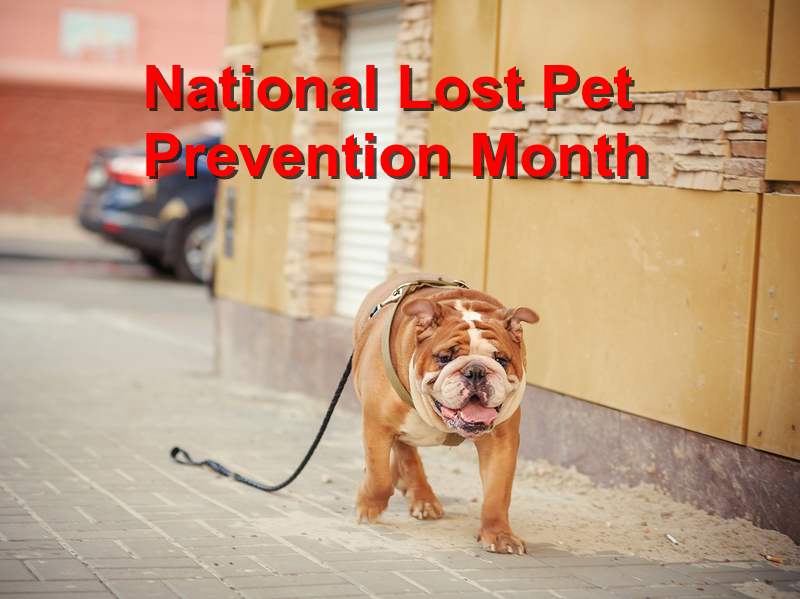
    One of the easiest and most practical ways of minimizing the chances of your barking buddy straying off is by keeping them on a comfortable leash or harness. And the leash ought to be always on, regardless of whether you’re just going for a short stroll to the mailbox or on a trip out of town. Remember that most pets are naturally inquisitive by nature; what might appear as a short dash after a stray squirrel might end up being a gruesome 6-hour long search. Keep him on a leash, always.

    Get your Pet a New Identification Collar

    A good collar is the best line of defense against accidental pet loss for two reasons. For starters, it effectively lessens the chances of your pet slipping off his leash. Secondly, a well-labeled collar makes recovering your pet remarkably easy in case he wanders off to another person’s home. What’s more, you can also have their collar fitted with a RFID microchip to make tracking them down far easier should they wander off accidentally. Alternatively, the chip can also be implanted directly under the animal’s skin.

    Obedience Training

    Nothing can forestall losing a pet more effectively than proper discipline and obedience training. Bear in mind that it is several times easier to lose an undisciplined pet than one that has been raised and taught to recognize and obey simple commands. Not to mention that highly disciplined and obedient pets will rarely stray or wander off even in the absence of a leash.

    SOURCE: Cat tipper

  • Animal Cruelty And Violence Awareness Week

    Animal Cruelty And Violence Awareness Week

    As family and friends of our furry, finned and fine-feathered treasured companions, there is no doubt that news of animal cruelty is likely to rub us the wrong way. A majority of us cannot start to imagine someone laying a hand on our delicate and precious friends. And it is quite unfortunate that millions of pets all over the world are constantly exposed to undeserved violence, cruelty, and gross mistreatment from their masters and owners. At this juncture, if you’re wondering whether there is anything you could do to help alleviate this suffering, then you could start by showing solidarity to a movement that was started back in April 1966.

    The ASPCA ( American Society for the Prevention of Cruelty to Animals ) annually dedicates the 30 days of the month of April to raise public awareness of animal cruelty. You can also lend them a hand by supporting their cause that seeks to make the world a better place for our pets. In the next 30 days, you can assist this humane organization, and fellow animal/pet lovers mark this special month by undertaking one or more of the following responsibilities.

    1. Assisting or volunteering at the nearest local animal shelter center. This is also an opportune time of adopting a new four-legged companion.

    2. Help raise public awareness ( and funds )of the plight that unadopted animals face every day that they spend on the streets unclaimed. The few animal shelters we have are trying to rein in this situation but still require your valuable input.

    3. Spreading the message about the significance of pets in our lives through social media channels using the hashtag #fightanimalcruelty.

    Also, follow ASPCA on Instagram, Pinterest, Facebook and Twitter and encourage your online buddies to follow them too. Commit to sharing at least one of their social media posts ( on your timeline ) every day for the 30 days of April.

    SOURCE: Cat Tipper,  ASPCA
    COPYRIGHT: Local Value

  • National Pet Day is Fast-approaching

    National Pet Day is Fast-approaching

    Typically commemorated every year on April 11th, the National Pet Day was started ten years ago in 2007 by family lifestyle and celebrity pet expert, Colleen Paige. Colleen is also the creator of Dress Up Your Pet day, National Cat day and National Kids day. He started this day as a way to pay homage and commemorate the importance of pet adoption in our society. On this day, pet parents are encouraged to spare some time to celebrate their finned, furry, or fine-feathered companions and the value they bring to their lives.

    You might be wondering what’s the best way of appreciating the presence of your pet in an otherwise busy lifestyle. Well, here are some suggestions.

    1. Spend some quality time with them.

    It is actually surprising and ironical that most of us rarely make some quality time to spend with our four-pawed companions. But on 11th of April this year, set apart a few hours to walk or feed, talk or sit with your pet. You will be surprised by how much they will enjoy and savor those few precious hours.

    2. Spoil them with a rare treat.
    When was the last time you bought your fur baby a present to mark their birthday or adoption? It might be a simple toy or a few hours of clawdicure; whichever way you choose to do it, they will feel appreciated and loved.

    3. Donate to a non-profit animal welfare organization on behalf of your kitty companion.

    In honor and celebration of that relentless devotion that your furry friend has shown you, take this day to give away a few hundred dollars to the nearest adoption home or a non-profit welfare group of your choice. Remember that these are same organizations that help keep our streets and neighborhoods safe by taking in stray dogs or homeless kittens that could be potential carriers of deadly zoonotic diseases if not immunized.

    SOURCE: Cat Piper
    COPYRIGHT: Local Value

  • Commemorating the National Pet Poison Prevention Week

    Commemorating the National Pet Poison Prevention Week

    The third week of March every year is routinely dedicated to raising awareness of pet poison prevention in the United States. And this year is no different: From March 19 to 25th, 2017, pet-owners are encouraged to join hands in eradicating the ever-present hazard of potential pet poisons in their homes and workplaces that are responsible for over a million deaths of our treasured companions every year.

    History of the NPPW ( National Pet Poison Prevention Week)

    It was first observed in March 1961 as a way of calling to attention the unseen dangers of pet poisons lying around in our homes and offices and how one can prevent accidental pet poisoning. In the past two years, hundreds of thousands of pets across the US, and millions of others in other countries have died from both deliberate and accidental chemical poisoning. This, coupled with the fact the environmental pollution is at its record high, has threatened to exterminate a significant pet population around the world.
    How you Can Join the Movement

    As a pet owner, you can contribute to this cause by playing your role in raising awareness of the unseen danger lurking in our homes in the form of potential pet poisons. It can be as simple as sharing ‘pet poison facts’ with your online family via social media tweets and hashtags either on Facebook, Instagram, or Twitter. Again, spread the message by viewing and sharing pet poison statistics [ http://poisoncontrol.utah.edu/publiced/pdfs/PoisonByTheNumbers2010.pdf ]

    In similar tandem, lead by example by cleaning out all potential pet poisons in your home’s basement, store, garage or cellar. This might range from unused and expired medicine tablets to undisposed old bottles that previously contained toxic substances such as household detergents and cleaning aids. Also, this is a good time to rid your garage of any potentially hazardous chemical. Alternatively, lock it up securely in a place where it is not easily accessible to pets.

    Poison Control Centers

    Lastly, when was the last time you visited or called your nearest poison control center or veterinary? The pet poison prevention week is also an opportune time to familiarize with the location and staff of your nearest poison center.

    SOURCE: American Association Poison Control Centers
    COPYRIGHT: Local Value