Category: Dogs

  • How To Choose The Perfect Shelter Dog

    How To Choose The Perfect Shelter Dog

    How To Choose The Perfect Shelter Dog

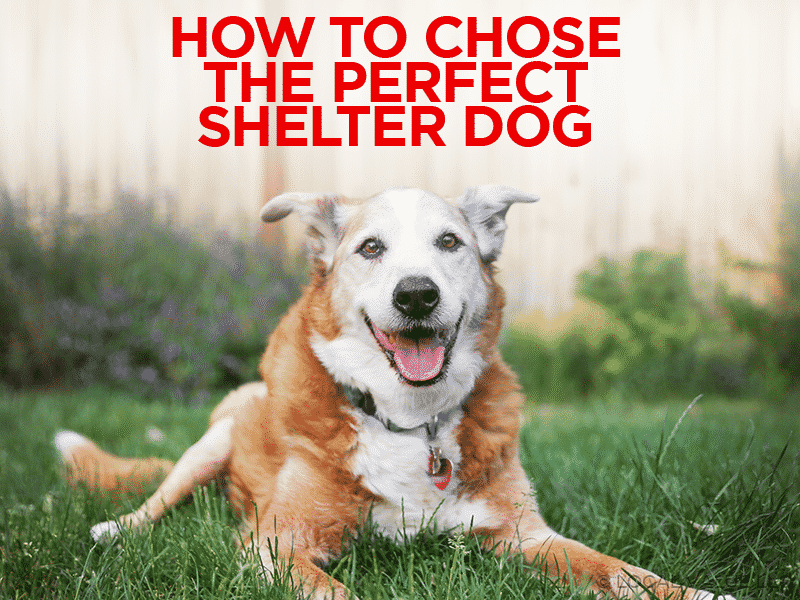
    It’s Adopt-A-Shelter Dog month and it’s the perfect time to bring a shelter dog home to join your family. If you’re thinking of adopting a new canine family member this month – or any month of the year – here are some tips to consider before choosing the perfect shelter dog for you and your family.

    Questions To Ask Yourself

    Why is the dog in the shelter in the first place?

    A stray’s history is an unknown, but if a dog was given up, you’ll want to know why. It may have nothing to do with the dog at all…in fact, it could have ran away, the owners neglected the animal or even a divorce in the family. You have to also consider that the previous owners got rid of the dog due to behavior problems Behavior problems are often treatable, but it’s good to know about them up front.

    Does the dog have any known medical issues?

    It’s better to know in advance if the dog has any medical ailments that might not be visible. You don’t want to be stuck with outrageous vet bills.

    Has the dog been temperament tested?

    Temperament tests try to gauge a dog’s personality and catch red flags such food and object aggression and overall temperament. However, if you do adopt a shelter dog, be careful and gauge the dog’s behavior for the first few weeks to make sure it doesn’t become aggressive with objects, other dogs and food.

    How Do I Select The Right Shelter?

    Picking the right shelter is the first step in picking your perfect shelter dog. While some communities have only one animal shelter, others may have two or even three shelters from which you can adopt.

    Schedule A Meet & Greet

    You can schedule a meet & greet so you can see how your potential shelter dog acts around your family. Spend plenty of time and get a good vibe for the dog. Does it feel like a good fit? Get to know it and make the wise decision.

    SOURCE: PetSafe
    COPYRIGHT: LocalValue

  • What World Rabies Day Means To Your Pet

    What World Rabies Day Means To Your Pet

    When rabies pops in your head you are probably thinking of a ferocious dog foaming at the mouth. While the drool, the frothing mouth, and the angry disposition are an accurate representation of a typical case of rabies, there is more to rabies that you should definitely know.

    Rabies is something you DON’T want your pet to end up with. It can affect all mammals.  Always fatal, rabies is a viral infection that affects your pet’s brain and central nervous system (CNS). Primarily spread through the bite of infected animals such as foxes, raccoons, bats, and skunks, rabies is a zoonotic infection that can affect all mammals, meaning it can be transmitted to humans.

    Risks/Symptoms

    Rabies is known to cause several symptoms, but there are some early signs. Early stages may merely cause mild abnormalities with the central nervous system, such as weakness and loss of coordination. This can last up to three days before progressing rather rapidly to the severe symptoms many are familiar with, ranging from paralysis to extreme behavior swings.

    Here’s a list of signs and symptoms to watch for:

    • Lack of coordination
    • Excessive salivation
    • Fever
    • Paralysis
    • Change in bark tone
    • Change in behavior/irritable/unusually shy or aggressive
    • Excessive salivation
    • Inability to swallow
    • Diagnosis/Treatment
    • Seizures

    If you think your pet may have been bitten or scratched by a potentially rabid animal, it’s crucial to contact your veterinarian immediately! Your pet must be quarantined to prevent the spread of the disease, and the amount of quarantine time depends on several factors, including state and local regulations, whether or not your pet was vaccinated against rabies, and/or whether or not the animal your pet encountered is a confirmed rabies case.

    Since there are other diseases that can cause behavior changes similar to those caused by rabies, your veterinarian may want to run tests to rule out other issues.  Furthermore, we recommend calling us for more information on protecting your pet from rabies.

    SOURCE: Pet Health Network
    COPYRIGHT: Local Value

  • Do Dogs Dream?

    Do Dogs Dream?

    There is no reason to believe that dogs do not dream, although it is not ascertained scientifically. There are certain behaviors associated with dogs when they are either asleep or fully awake. These include whining, tail wagging, leg paddling, and twitching noses. These activities definitely arouse curiosity about the idea of dogs’ dreams.

    Current information on dogs and dreams

    Although scientific knowledge on this aspect of dogs is limited, there is plausible data that may lend credibility to the occurrence of dreams in dogs. Matthew Wilson, a professor of neuroscience and graduate student Kenway Louie conducted an interesting study on memory, sleep, and dreams. One experiment on rats revealed that after the rodents were trained to complete a track for treats, a distinct pattern of neurons was created in their brains.

    This experiment was conducted again as the rats were asleep. It revealed the same distinct brain activity that was evident as the rats were running on the track. Additionally, the memories of the rats at both instances played at near similar speeds.

    Application to Dogs

    The main question is whether the data on rats and humans can be applied to dogs. Matthew Wilson seems to believe so. He bases this belief on the fact that the hippocampus; the organ responsible for the collection and storage of memories, functions the same way in all animals. He concludes that the same dreaming process that occurs in humans must also occur in dogs.

    In humans, most dreams occur during rapid eye movement (REM) sleep. Dogs also exhibit this sleeping patterns and activities associated with dreaming such as rapid eye movements, leg paddling, and twitching can be observed during this phase.

    Inference In Relation To Dogs

    Going by the information from the study by Wilson and Louie, it is definitely not far-fetched to believe that dogs possibly reenact their favorite daily activities. Sigmund Freud’s theory about dreams being a safety valve for unconscious desires could possibly be true. These canines may be dreaming about activities that they are looking forward to doing.

    SOURCE: Pet Health Network
    COPYRIGHT: Local Value


  • 10 Tips To Being A Responsible Pet Owner

    10 Tips To Being A Responsible Pet Owner

    What does it mean to be a responsible pet owner? I’m sure if you asked fifty people, you would get fifty different answers, but the overall outlook would be roughly the same. We want nothing but the best for our fur babies…even if that means restricting them from table scraps, limiting their toys, etc. Here are 10 tips to being a better, more responsible pet owner.

    1. Carefully choose your dog. Don’t purchase a puppy because they are cute. Your dog selection should be based on your lifestyle.
    2. Socialize your dog.  Make sure your pet is socialized and if your dog is a puppy, make sure to socialize them. The goal is to make your puppy comfortable and at ease around other people and animals.
    3. Don’t threaten your dog. Don’t put your dog in a position where it feels threatened or teased.
    4. Train your dog. Basic commands are always a work in progress so don’t think you train them and that’s it. Continue to stimulate Fido’s mind with commands like “sit”, “stay”, “leave it”, “come”, “take nicely”, etc.
    5. Excercise.  Exercise your dog regularly and they will thank you! It will keep them healthy and stimulate them mentally.
    6. Not too much action.  Avoid highly excitable games like wrestling.
    7. Leashes.  Use a leash in public to make sure your dog is controlled at all times. You are in control of your dog and you want that to show to others.
    8. Keep your dog healthy. Make sure your pets vaccinations are ALL up to date. If you can’t remember when your dogs shots where, contact us.
    9. Spay or neuter your dog. If you decide to spay or neuter your dog you have options. Give us a call and discuss your options with us so you can make a decision that is right for you, your family and your dog.
    10. Fence your dog.  If you have a fenced yard, make sure the gates and fence are secure. You don’t want your dog to run out in the street and risk getting hit by a car or even taken. There have been cases of dogs running away and other people taking the pet tag off and keeping it so don’t run risk!

    SOURCE: AVMA
    COPYRIGHT: Local Value

  • 5 Labor Day Tips for Pets

    5 Labor Day Tips for Pets

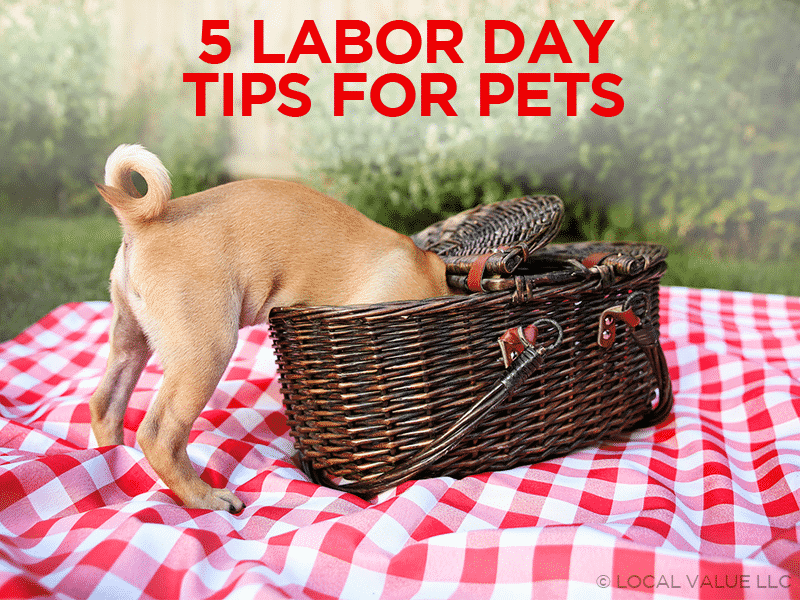
    It’s not just humans who love the summer. Our pets love the summer just as much as we do. Our dogs love to bask in the sun as much as swimming, running or just enjoying a nap in the yard with the family. There are some tips to make sure your Memorial Day doesn’t get out of hand.

    1. Think twice about giving that bone to your dog

    While it’s very tempting, it can also be life-threatening. Along with bones, BBQ bits, like gristle and fat should never be given to your dog. Certain breeds and dogs that are overweight are subject to pancreatitis.

    1. Make sure your pet has plenty of fresh water and shade

    Our pets, especially dogs, get much thirstier than we do when they get hot, and other than panting and drinking, they really have no way to cool themselves down. Get your pet in the shade as often as possible. While dogs and cats like to sunbathe, direct sunlight can overheat them (especially dogs) and cause heat stroke.

    1. Never ever leave your pet in the car

    It can take minutes – yes, MINUTES – for a pet to develop heat stroke and suffocate in a car. Most people don’t realize how hot it gets in parked cars.

    1. Keep pets away from fireworks

    For us, fireworks are the highlight of the night, however, many pets are terrified of them. The loud noises and bright lights easily scare pets, which will make them want to get as far away as possible. Fireworks are also harmful to pets even when they’re not lit, as they contain hazardous chemicals.

    1. Make sure your pup has his ID tag on

    We love bringing our pets places, it means we get to spend more time with them! However, when you bring your pet to an outing, be sure they are wearing their collar with up-to-date ID tags just in case they wander off. It never hurts to be careful.

    SOURCE: Pet Health Network
    COPYRIGHT: Local Value

  • National Dog Day – Obedience 101

    National Dog Day – Obedience 101

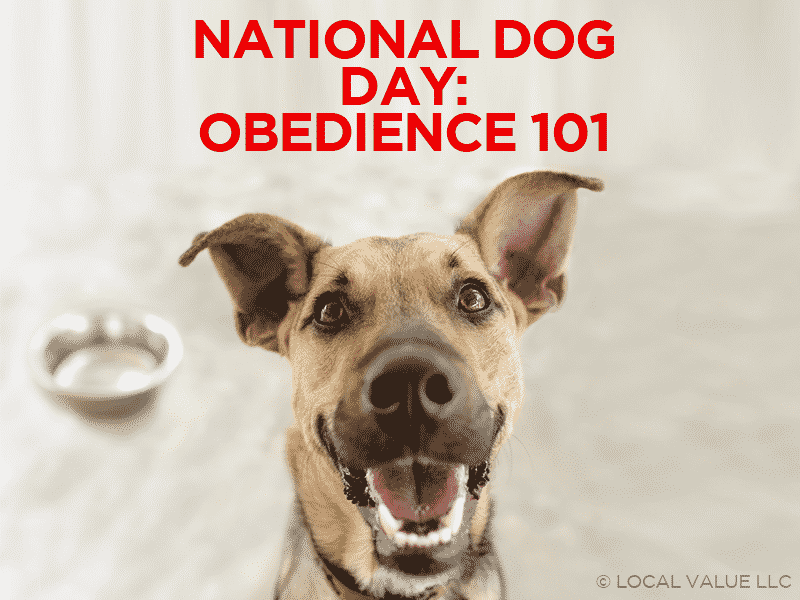
    As pet owners, we’ve always celebrated our pet’s birthday. National Dog Day is no different. We go to the local pet store and pick up some toys and healthy treats and spend extra attention on them. After all, they deserve it!

    National Dog Day is a good day to dust off some old tricks that you and your canine buddy used to practice or brush up on his obedience drills. Here are a few tips:

    1. Understand the basics of how your pet learns – Behaviors that are reinforced are more likely to be repeated, and behaviors that are ignored are more likely to be stopped because they bring no benefit to your pet.
    1. Your dog cannot understand human speech – Dogs “speak” to each other using body language and various types of vocalizations so learning to understand what your dog’s signals mean can lead to stronger relationship.
    1. Always be positive when working with your dog –  Dogs enjoy learning if they don’t feel unduly stressed and you want to focus on building a positive relationship.
    1. Keep your training sessions short and train in small increments throughout the day – Dogs learn best in small increments, and by making sessions shorter it becomes more likely you’ll find the time to train your dog every day.  Your dog will get bored fast so that’s another great reason to train in short sessions.
    1. Teach your dog new behaviors in quiet, low-distraction areas – Once your dog is behaving well, slowly add in distractions. Don’t be surprised if you have to go back to square one with some behaviors after distractions are added in.
    1. Make training part of your daily routine – Ask your dog to sit before going in and out of doors, have your dog do “down stays” while you’re watching TV, etc. By asking the dog to do these behaviors as part of “daily life” the dog will learn to offer these behaviors without prompting.
    1. Make sure everyone in your household is on the same page – This is very important because your dog can learn bad habits from a roommate or family member when you are not around. Make certain everyone is on the same page. Be sure everyone uses the same words and hand signals that you use with the dog for each behavior. Being 100% consistent helps your dog to learn faster and find training less confusing.

    SOURCE: Pet Health Network
    COPYRIGHT: Local Value

  • Honoring International Assistance Dog Day

    Honoring International Assistance Dog Day

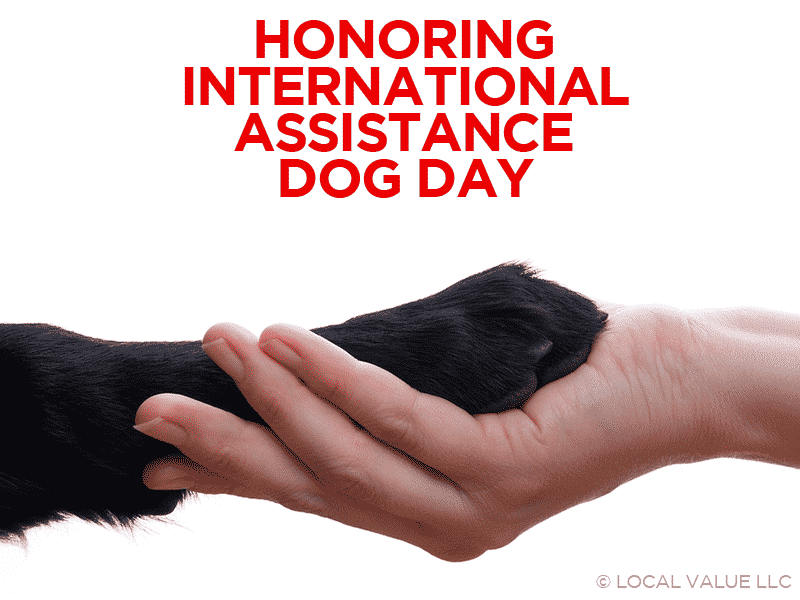
    A service or special assistance dog is specially trained to assist humans with disabilities. They are many of people’s eyes and ears, assisting with sight or hearing. But there is more to just sight and hearing.  Many service dogs help companions cope with various mental conditions like post-traumatic stress syndrome and autism.

    Service dogs might also support people with medical conditions including diabetes, epilepsy, narcolepsy and severe allergies. They can be trained to pull wheelchairs or carry oxygen, life-support equipment or medications for their human partners. The list goes on and on.

    Service dogs earn another important designation: They are protected under the 1990 Code of Federal Regulations for the Americans with Disabilities Act (ADA). This provides access to service animals working with their humans in any area where the public is permitted. It is not unusual to find service dogs with their human partner in malls, restaurants, theaters, hotels, amusement parks, on trains, buses or planes. Anywhere people go, their service companions may follow!

    Therapy dogs come in all shapes, sizes and breeds. They are trained to provide comfort, affection, and entertainment to people in nursing homes, hospitals, prisons, schools and retirement homes. These working dogs are often used in therapeutic environments such as assisting with teaching children experiencing learning disabilities and as stress-reducers with victims of accidents, crimes, and natural disasters/crises.

    Therapy dogs are not service dogs — and are not protected by the ADA regulations. Public institutions may limit or prohibit access to a therapy dog. Training required for a therapy dog designation varies, but it is much less rigorous than that of service dogs.

    Regardless of the tag, working dog, service dog, therapy dog or professional working dogs remain our best friends, favorite family, loyal assistants and, in most cases, our heroes!

    We have all seen a police dog, service dog or therapy dog in our lives and hopefully when you see them you will honor these guys for their loyalty and courageous efforts!

    SOURCE: PetFul
    COPYRIGHT: Local Value

  • Adopt a Mutt on Mutt’s Day!

    Adopt a Mutt on Mutt’s Day!

    Adopt a Mutt on Mutt’s Day!

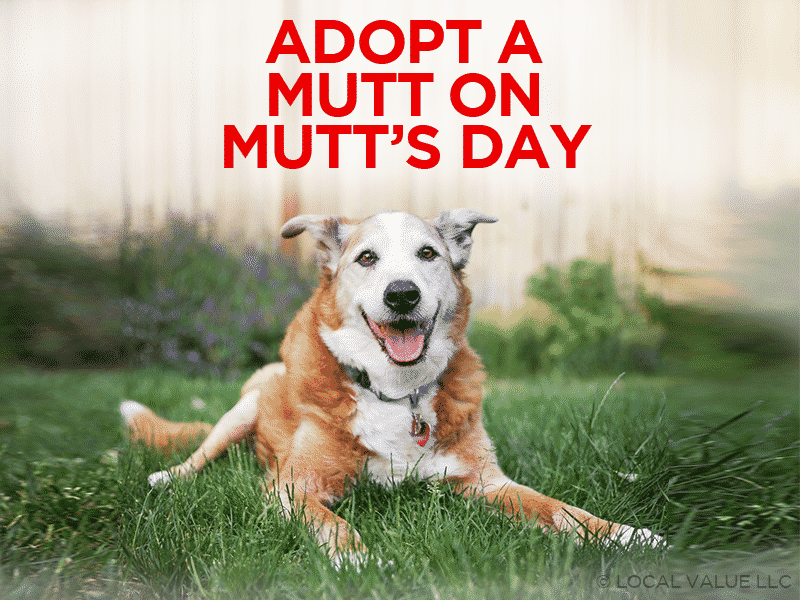
    July 31st is Mutt’s Day, where we celebrate our adorable mixed breed buddies. Have you been thinking about getting another dog or adopting your first? Adopt a mutt – the best of all worlds!

    When its time to get a dog, every potential owner ask this question… “Should I adopt a mutt or go with a purebred?” While purebreds can be attractive because they have district traits and characteristics, mixed breed dogs can offer more benefits that might be more appealing to the average down owner. Before you fork out the big bucks on a purebred, consider these reasons to go mutt!

    Many years ago, to bring awareness to this awesome type of dog, a brilliant poster was printed up by one of the national animal welfare organizations. The poster read, “Decide Between a Shepherd, a Setter or a Poodle?  Get the Best of Everything—Adopt a Mutt!”

    That was excellent the, and still is excellent advice today! Truth be told, most dogs are pretty darn awesome.  When you are adopting from a local shelter, you can find a new best friend AND save a life. Most shelters are full of mutts and end up in the shelter because people think there is something wrong with them or they are faulty. Most dogs that are surrendered to shelters had owners with unrealistic expectations and didn’t estimate the amount of time, effort and money it takes to train any dog, purebred or mutt.

    Mix breed dogs are truly unique as they carry traits and characteristics from different types of dogs, instead of just one. Whether you’re looking for long-hair or short, wire-hair or curly, long tail or docked, big dog or little, terrier, spaniel, retriever or toy breed – the shelter can introduce you to your new best friend!

    Can’t decide between a shepherd, a setter or a poodle?  Get the best of everything…Adopt a MUTT!

    SOURCE: Pet Safe
    COPYRIGHT: Local Value LLC