Tag: #cat

  • Helpful Tips to Keep Your Cat Out of Your Christmas Tree

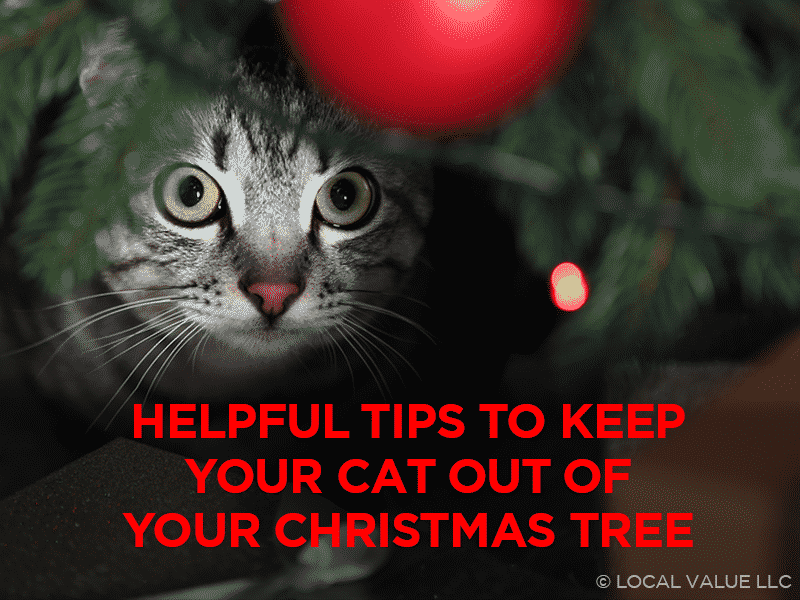
    Helpful Tips to Keep Your Cat Out of Your Christmas Tree

    Are you getting ready for the hectic holiday season? We are, and if you’re like us, getting a Christmas tree is a top priority and has been a holiday tradition for ages. And if you have a cat, well, keep in mind that the tree makes a tempting target for many mischievous cats out there. Here are some tips on how to pet-proof your Christmas tree.

    To buy a real tree or not to buy a real tree

    When it comes to Christmas trees, isn’t it better to have a real tree over a fake one?  After all, they fill your house with the holiday smells of, well, holidays. However, keep in mind that if you have cats, real trees are much more tempting. Not only are real trees fragrant and the pine needles more fun to chew on (thankfully, rarely poisonous) but the tree trunk is perfect for scratching and climbing. Consider an artificial tree. If you do get a real tree, avoid one that is very tall, as a tall tree would be more likely to topple over when kitty takes a courageous hike to the top.

    Placement of the Christmas tree

    There big question. Where do you put your Christmas tree? Make sure you have plenty of space on each side of the tree so your cat doesn’t have a launching point to attack the tree! Ideally, place it in an area with an equal amount of free space as the height of the tree (i.e., if the tree is 8 feet tall, consider leaving an 8 foot berth around it).

    Securing the Christmas tree

    The base you use should be extremely sturdy. Dill into the base stump as that has proven to provide enough stability and if kitty DOES run up the tree, it decreases the chance of it toppling over.  While these bases are ugly, it beats having your tree topple. You can also wrap a dressing over the metal rods of the base so it’s not so ugly. You can also take an extra measure and drill a hook (use an anchor!) in the ceiling and attach a wire to the tree for an extra precautionary measure.

    5 Ways to Pet-Proof Your Christmas Tree

    Here are a few ways to pet-proof your Christmas tree:

    • When watering your real tree, consider wrapping the base with plastic wrap so your cat doesn’t drink the fertilizer or chemicals. (Don’t worry, these are hardly ever poisonous, however they can cause gastrointestinal upset.)
    • If you have a real Christmas tree, wrap the base of the trunk with aluminum foil. Cats can’t stand the sound and texture of foil! If you wrap the base with foil, the less likely they will claw up the tree trunk. Also, by wrapping the tree trunk with foil hopefully you will prevent the initial climb.
    • Do not hang dangling ornaments on the bottom of the tree. Rather place ornaments up high on the tree and as an extra precautionary measure, make sure they are well secured (try twisty ties or zip ties to secure ornaments).
    • Never use tinsel in a household with cats. While tinsel isn’t poisonous, when accidentally swallowed by cats, it can get stuck around the base of the tongue or in the stomach, and the result can be life-threatening.
    • Make sure you hide all electric chords for the Christmas lights as best you can. When accidentally bitten, they can result in severe burns in the mouth and even rare fluid accumulation within the lungs (e.g., noncardiogenic pulmonary edema). Hide cords, and consider spraying them with Bitter Apple to prevent chewing. Also, make sure to turn off the Christmas lights and unplug the cords when cats are unsupervised. This is especially true for kittens.

    Let’s keep our pets safe this holiday season!  Know all the precautions and keep your house safe while saving an emergency trip to your veterinarian!

    Source: Pet Health Network
    Copyright: Local Value

  • Heat Stroke & Your Cat

    Heat Stroke & Your Cat

    Heat Stroke and Your Cat

    We are in the height of the summer, and don’t let it slip your mind that your cats can be affected by the heat just like dogs can be. During the hottest days of the year make certain to keep your feline friend in mind and comfortable this summer. Every year, many cats are exposed to high temperatures of heat and tragically some become overheated.

    Heat stroke is a life-threatening condition where the body’s internal organs begin to shut down as a result of elevated body temperature caused by high temperatures. Here are a few ways you can help prevent this from happening to your cat.

    While cats might not take as many road trips as your dog companions do, that doesn’t mean that cats aren’t ever in the vehicle. It is common for cats to take rides in the car while going to the vet. Just like dogs, even being left in the car for a few minutes while you run in the store can be harmful to your cat and cause a heat stroke.

    A general rule of thumb is that if people are comfortable with the temperature, your animals probably are too! That being said, it is always wise to watch for signs of heat stroke, as cats don’t have a way of regulating their body temperature like humans have. They cool their body like dogs, by panting and perspiration on their footpads. However, neither method is effective in cooling them off in high heat situations.

    Even when it isn’t too hot, your cat can feel much hotter in a small space with no ventilation so it is important to keep that window open or the air on for kitty.

    Keep an eye on your cat and make sure they don’t display any of the following signs.

    • Panting
    • Red Tongue
    • Dark Red Gums
    • Pale Gums
    • Drooling
    • Weakness
    • Anxiety

    If your cat exhibits any of these signs, call us or bring your cat to the vet immediately!

    By following these tips and being aware of the temperature and your cat’s surroundings, you will ensure to keep kitty safe from heat stroke this summer. If you have any questions or concerns, you should always visit or call your veterinarian — we are your best resource to ensure the health and well-being of your pets.

    SOURCE: Pet Health Network
    COPYRIGHT: Local Value LLC

  • 5 Questions to Ask at Your Cat’s Next Veterinarian Exam

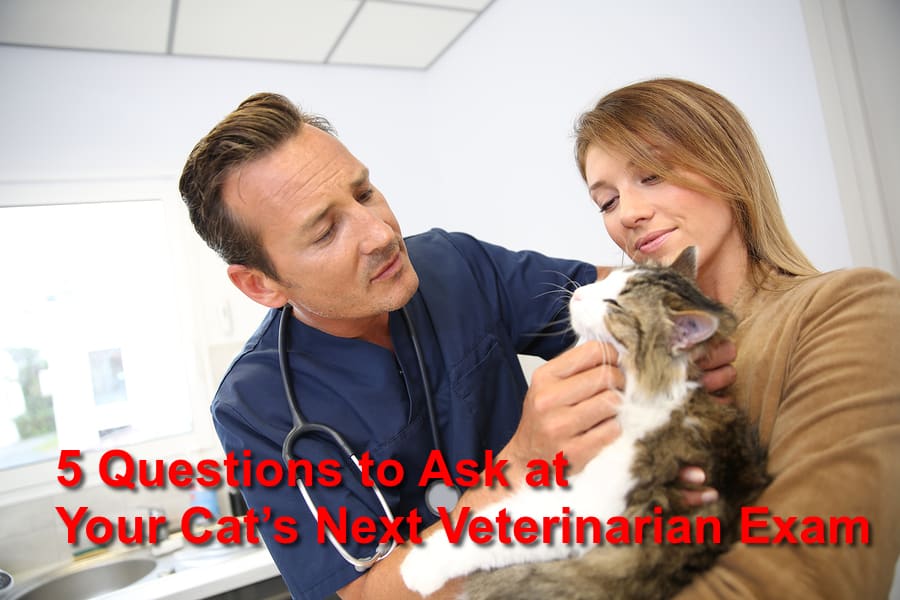
    5 Questions to Ask at Your Cat’s Next Veterinarian Exam

    It is important to ask your veterinarian the list of questions below at least once a year, as answers may change from year to year. Write it down and bring the list with you so that once your veterinarian is done explaining things you can look at your list to see if he or she has answered all of your questions.

    1. Is my cat at a healthy weight?
      According to a study from the Association for Pet Obesity Prevention, about 53% of cats are overweight. Overweight cats are predisposed to a number of health issues, and diabetes is at the top of the list. Ask the question to get an honest answer from your vet on your cat’s body condition.
    2. What should I feed my cat?
      It is important to learn more about what type of diet will best support your cat’s health. Ask about canned versus dry food and whether or not your veterinarian recommends a specific brand for your kitty.
    3. Which vaccinations are appropriate for my cat?
      There is no “one size fits all”. To answer this question your veterinarian will need to know your cat’s prior vaccination history, if your cat has contact with other cats, if it travels with you, etc.
    4. Should be doing anything different at home?
      Your vet may recommend that you change things at home a bit depending on your cat’s age and health. For instance, he or she may request that you increase litter box access to your older cat that has a bladder issue. So make sure to ask if you should be doing anything different at home!
    5. When should I bring my cat back?
      Always find out what is supposed to happen next after seeing your cat’s veterinarian. The goal here is to always come away with a plan.
  • Adopt a Cat Month – Top 5 Reasons You Should Adopt a Cat

    Adopt a Cat Month – Top 5 Reasons You Should Adopt a Cat

    1. Cats are very independent, which means that little supervision is needed.
    2. Kittens don’t need to learn where to do their business, they come potty trained! Just get your kitten a litter box and it will know what to do.
    3. You are saving a life. Over 40% of cats entering shelters are euthanized every year. (https://www.aspca.org/about-us/faq/pet-statistics)
    4. Indoor cats generally don’t need baths – they bathe themselves!
    5. Owning a cat is good for your health! Cats particularly lower the amount of stress from your life and could potentially lower your chances of having heart diseases. (http://www.medicalnewstoday.com/articles/98432.php)